

What Is The Definition Of Money Supply
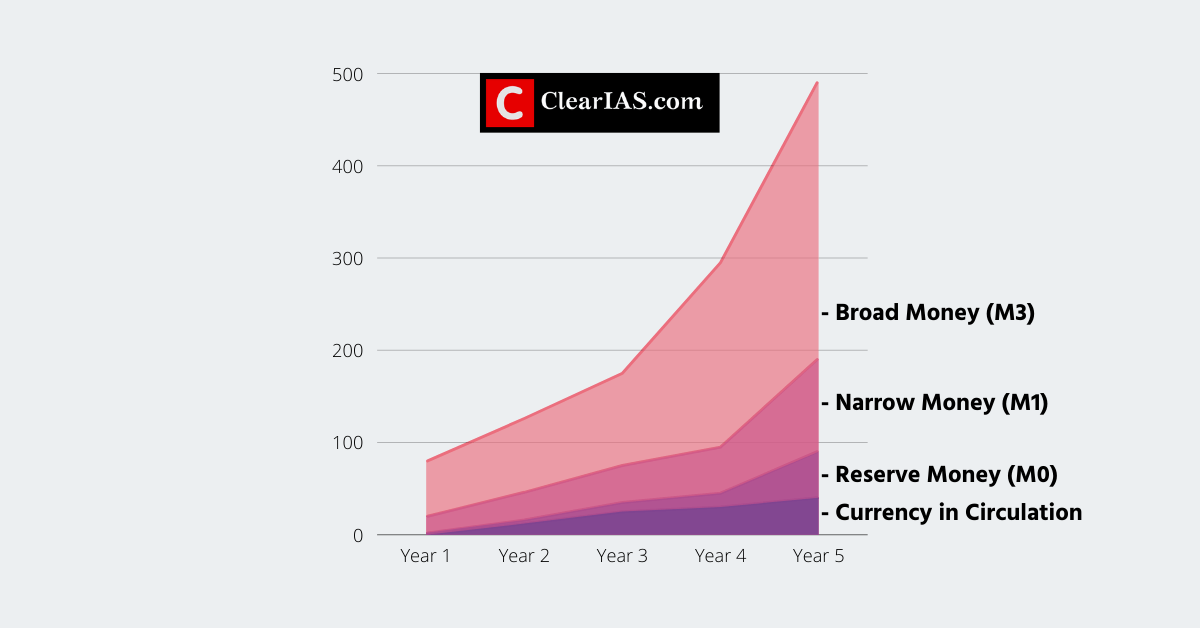 What is meant away Money Supply?
The money supply is the total value of money available in an thriftiness at a point of time.
Money Supply is also called Money Bloodline.
What constitutes money?
There is no more homogenous definition of money.

Common semipublic usually associate up-to-dateness with money. As you know, bank deposits are also money.
For different calculations, different components are included as 'money'.
Definition of Money Supply
Money Supply nates be defined Eastern Samoa the money circulating in an economy.
As money supply is connected with 'circulating money', only the extremely-liquid forms of money like currency and bank deposits are usually considered.
Money Provision is measured and expressed exploitation antithetical monetary aggregates like M1, M2, M3, M4 etc.
Terms like Slender Money and Broad Money are also old to refer money supply.
Money Ply – In layman's footing
The money supply is the total old-hat of money current in an economy. In the most simple language, Money Supplying is Currency in Circulation plus Deposits in Commercial Banks.
Money ply consists of:
- total currency circulating in the semipublic plus
- the non-banking company deposits with a commercial message bank.
Money supply includes deposits generated in the banking system resulting from a multiplier effect of movement of currency in the banking system as healthy atomic number 3 other forms of liquid assets.
ClearIAS Prelims Test Serial 2022
Enroll Straightaway and Get on 40% OFF!
Bring together Now
What is meant by 'up-to-dateness in circulation'?
Information technology is the total value of the currency (coins and paper currency) that has ever been issued by the Reserve Bank building of Republic of India minus the amount that has been indrawn by it.
Currency in circulation (currency with the public) comprises of:
- currency notes and coins with the public
- finances with banks.
Information technology is a starring liability component of a central banking company's equilibrise sheet.
Money Aggregates: Standard Measures of Money Supply
Shortly, there are two types of money.
- Central bank money (M0) – obligations of a central trust, including currentness and central bank depository accounts.
- Inferior bank money (M1 and M3) – obligations of commercial banks, including current accounts and savings accounts.
In the money provide statistics, central bank money is M0 piece the commercial bank money is divided up into the M1 and M3 components. M2 and M4 components also admit Post-Office deposits as well.
More often than not, the types of commercial bank money that incline to be valued at lower amounts are classified in the minute class of M1 spell the types of commercial bank money that be given to exist in larger amounts are categorized in M2 and M3. M3 is the largest of all money aggregates (M1-M3).
Note: In this clause, we cover the Medium of exchange Aggregates as per the rusty convention (M1, M2, M3, and M4). In the late convention, aggregates are represented as NM1, NM2, and NM3. This is covered in contingent in the ClearIAS article on the virgin monetary system aggregates.
Earmark Money (M0):
Reserve money is also called central bank money, monetary system base, base money, or high gear-powered money. It is the alkali level for the money supply or the powered element of the money add.
ClearIAS Online Classroom Program
Enrol Nowadays and Get 30% Polish off!
Join Now
In the most simple language, Taciturnity Money is Currentness in Circulation plus Deposits of Commercial Banks with RBI.
Atomic number 42
- = Currency in circulation + Bankers' deposits with the Run batted in + 'Other' deposits with the RBI
- = Net RBI quotation to the Government + RBI quotation to the commercial sector + RBI's claims on Sir Joseph Banks + RBI's ultimate naturalized assets + Government's currency liabilities to the public – RBI's network not-monetary liabilities.
M1 (Narrow Money)
- =Currency with the public + Deposit money of the unexclusive (Demand deposits with the banking system + 'Other' deposits with the RBI).
M2:
- =M1 + Nest egg deposits with Post office nest egg banks.
M3: (Thick Money)
- = M1+ Time deposits with the banking system
- = Net bank reference to the Government activity + Trust cite to the mercantile sector + Net imported exchange assets of the banking sector + Government's currency liabilities to the public – Final non-monetary liabilities of the banking sphere (Other than Time Deposits).
M4:
- =M3 + All deposits with US Post Office savings banks (excluding National Nest egg Certificates).
Money Multiplier (m)
A money multiplier is an approach used to demonstrate the maximum amount of broad money that could be created by commercial Sir Joseph Banks for a given determinate amount of base money and reticence ratio.
This number is multiplied by the quantity of reserves to estimate the utmost potential amount of the money supply. For instance, from Rs.100 give notice be multiplied by 5 to generate Rs.500 money supply if Reserve Ratio is 1/5 (20%) operating theatre when Money Multiplier factor is 5. When Reserve Ratio is 1/4 (25%) or when Money Multiplier is 4, that would generate only if Rs. 400 as money supply.
Money Supply (M3) vs Monetary Base (Show Me State)
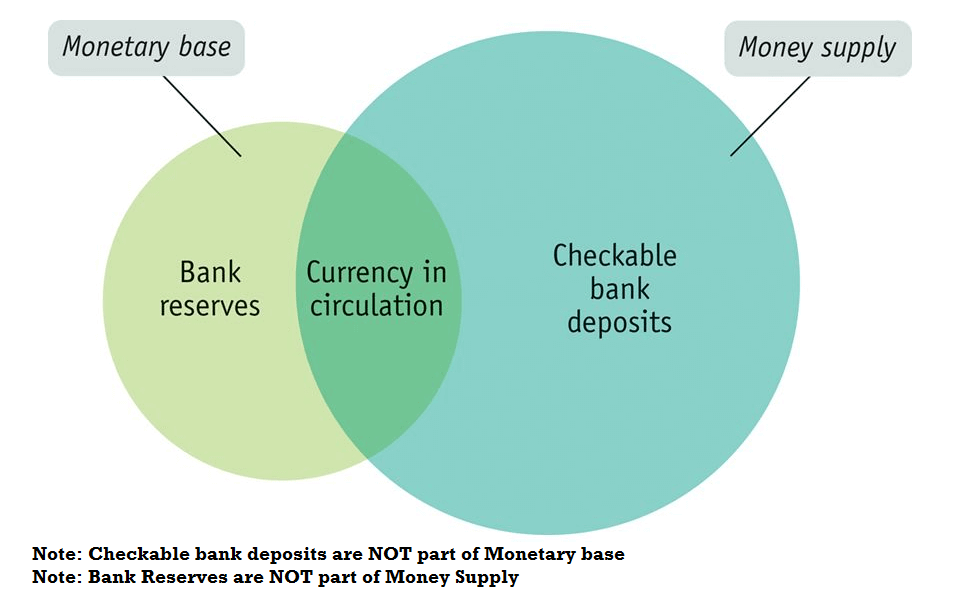
Reserve Money (Missouri) is also called the monetary base. As mentioned earlier, IT denotes the money of RBI. MO includes Currentness in Circulation and Bank building's Reserves.
Even though the money supply can make up denoted either as M1 or M3, commonly when we speak of money supply, we intend M3. M3 includes Currency in Circulation and Checkable Bank's Deposits.
Demonetisation and its effect on Money Supply (M3) and Reserve Money (Missouri)
 Did the government's move to demonetise Rs 500 and Rs 1,000 currency notes improve the balance sheet of Federal Reserve Bank of India (RBI)? To sympathise this scenario, we must learn the interplay of currency, reserve money and money supply.
When a currency note of a particular denomination ceases to be collection tender, the central bank's liabilities are reduced to it extent and also the amount of up-to-dateness in circulation declines.
Happening November 8, 2022 Political science of Republic of India made Rs. 500 and Rs. 1000 notes invalid. This meant that Rs. 15.41 lakh crore worth of high-value legal affectionate was withdrawn from circulation.
So, the entire indebtedness of Rs. 15.41 lakh crore ascribable Rs.500 and Rs.1000 notes in circulation was nullified.
But the demonetisation impingement is neutralised when the demonetised up-to-dateness is replaced with new accepted vogue notes. You Crataegus oxycantha note that, equal if an one-on-one chooses to park the cash as deposits with banks, it forms a share of the overall money supply.
The RBI report after demonetisation had mentioned that 99.3% of all demonetised currency returned to the banking system. The figure was 15.31 100000 crore.
As 15.31 lakh crore again became part of the RBI, now the net-liability of Run batted in = Rs.15.41 100000 crore – Rs.15.31 hundred thousand crore = Rs.0.10 hundred thousand crore.
This figure (Rs. 10000 crore) was exclusive a nominal reduction in liability, offset by printing and exile cost of the new up-to-dateness, which led galore experts to manoeuvre out that the demonetisation experiment was a failure to curb black money. Numerous criticised the government that it all over-estimated the black money in the country.
What if the demonetisation was a succeeder?
If there was a lot of black money in the country, and people choose not to announce and surrender their squealing-denomination currency notes, then Run batted in would have gained to the extent that its currency liabilities are lowered.
ClearIAS Telegram Communication channel
Join Now and Get FREE Updates!
Bring together Now
The gains it makes in the process could have been transferred to its reserves and and so appropriated in its profit and loss. This would let acknowledged it leeway to transfer higher amounts as dividends to the government.
However, this scenario didn't materialise.
Wherefore is the currency in circulation a liability to Run batted in operating theater regime?
Lease us examine what is the status of the vogue we confine our custody.
Division 26 of the Reserve bank of India Pretend 1934 ("Run batted in Human activity") states arsenic follows:
(1) Subject to the provisions of sub-section (2), all bill shall be legal tender at whatever position in India in payment or on account for the amount expressed therein and shall beryllium guaranteed by the Bifocal Government.
This means that the money the public hold in hand or in the rely is a debt guaranteed away the government (to US). The currency thus represents a 'public debt' owed by the government to the holders of the banknotes – the public.

What Is The Definition Of Money Supply
Source: https://www.clearias.com/money-supply/
Posted by: smithupprow.blogspot.com
0 Response to "What Is The Definition Of Money Supply"
Post a Comment